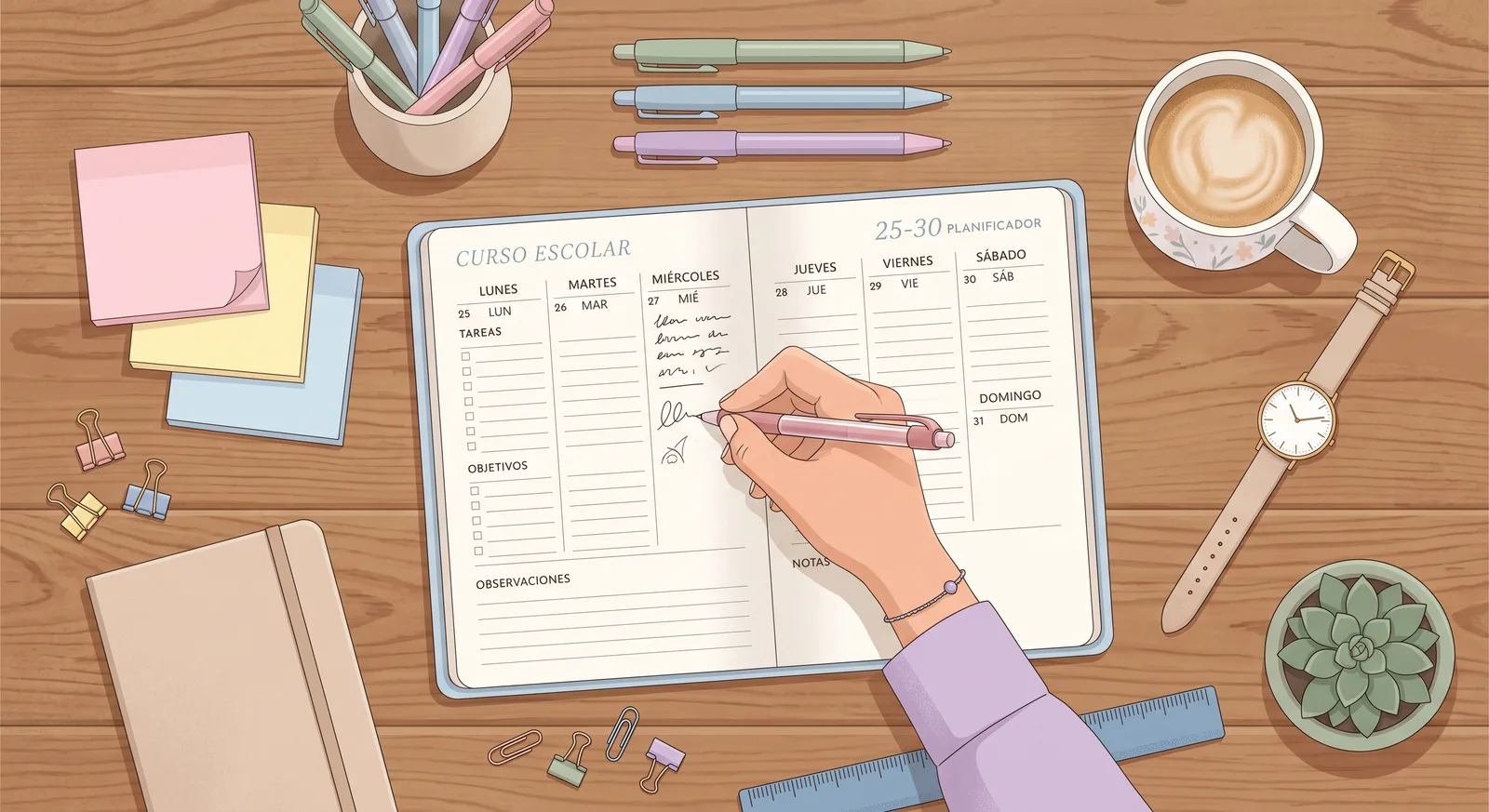
You get a brand-new planner in September, write down every date, colour-code your afternoons by subject, and for a few days you feel that this year, at last, you have everything under control. Then the second week arrives, an exam gets moved forward, one afternoon goes sideways, and the perfect calendar ends up forgotten at the bottom of your backpack.
It is not a lack of willpower. The problem is believing that a detailed plan guarantees good results, when what really works is knowing how to plan your school year with a system that can take a few hits. In this guide we look at what a planner can do for you, what it can't, and how to build one that is still alive in June.
Key takeaways
- Planning is not studying, it is deciding what to study each day.
- The more minute-by-minute the plan, the sooner it breaks.
- Over-organising is an elegant way of procrastinating.
- A good plan leaves room for setbacks and rest.
What a plan does for your brain (and what it doesn't)
Planning works because it reduces cognitive load, that is, the number of things your working memory has to hold at the same time. When exam dates, deadlines and reviews are written down somewhere reliable, you stop spending energy remembering what is due today. The system holds that information, not you.
The catch is that this effort often stays on paper. Planning is preparation: having the plan is like having a map of the mountain, it shows you the way up, but it does not move you one metre closer to the top. The point is not to have the perfect planner, but for the planner to send you to study.
Why it is worth planning your school year
No plan is set in stone, but used with judgement it gives you three clear advantages:
- Less anxiety: When everything is written down, the syllabus stops being an endless mountain and becomes small steps you can start today.
- A long-term view: You can see weeks in advance when deadlines and exams overlap, and you avoid the classic all-nighter before the test.
- Clear study phases: The plan tells you when to read, when to highlight what matters, and do it properly, and when to start testing yourself.
Notice that none of the three is "learning". They are organisational advantages, and that is exactly where their limit lies.
When planning is a waste of time
Designing routines without a strategy does not get you very far. These are the most common mistakes at the start of the year:
1. Aesthetic procrastination
- Mistake: Spending three hours picking colours, doing lettering and setting up templates, and zero hours studying.
- Fix: Give yourself a single afternoon to set the system up. If you are still decorating after that, the plan has become an excuse.
2. The minute-by-minute plan
- Mistake: Scheduling "4:00 to 4:45 Chemistry, 4:45 to 5:30 Biology". All it takes is one long lunch for the whole block to collapse.
- Fix: Assign tasks per afternoon, not fixed time slots, and keep the order within the afternoon flexible.
3. Confusing ticking boxes with making progress
- Mistake: Filling in a habit tracker gives an instant sense of satisfaction that feels a lot like having worked, and that is the trap, an illusion of progress.
- Fix: Only tick off things that leave evidence: a summarised topic, a finished quiz, a list of mistakes written down.
4. A plan with no rest
- Mistake: Leaving no time for sport, going out or simply doing nothing. A plan like that is headed for burnout before the first term exams.
- Fix: Write rest into the planner in the same ink as your exams. It is non-negotiable, not a reward.
How to plan well from day one
To make organisation work for you and not the other way round, follow these five rules:
- Use a hybrid system: Don't force yourself to go 100% digital if it doesn't suit you. A notebook, a printed calendar on the wall and a couple of phone alarms are usually the balance that best keeps you focused.
- Define tasks, not just hours: Don't write "study from 4 to 6". Write "two pomodoros (25-minute blocks with a 5-minute break): one to summarise topic 1 and one to move my mistakes into the error notebook".
- Keep the look simple: Few colours, a clean layout and a couple of markers. A fluorescent rainbow tires your eyes faster and takes longer to maintain.
- Leave a 20% buffer: Plan only about four fifths of your study time. The free space absorbs setbacks, tired days and topics that turn out harder than expected.
- Do a weekly review: On Sunday afternoon, look at what worked and what didn't, and adjust the next week based on what actually happened, not on what you wish you had done.
The buffer rule is the hardest one to accept and the one that saves the most plans. Simple, but very powerful.
Combine planning with techniques that work
Planning pays off most when it is the skeleton of your system and you build evidence-based techniques on top of it:
- Spaced repetition: Use your calendar to schedule when you come back to each topic: the next day, three days later and a week later. That is how spaced repetition works.
- Active recall: Block out fixed slots to test yourself without looking at your notes, because active recall is what turns study hours into memory.
- Timed mock exams: Keep one weekend morning before each round of exams for practice tests under real conditions.
If you want to see how all these pieces fit together, the full map is in our guide to study techniques.
From plan to practice with Selectiva App
Here is the usual friction. Having the plan is easy; preparing by hand the quizzes, the flashcards and the review schedule that the plan asks of you every afternoon eats up exactly the hours you wanted to spend studying.
That is why in Selectiva App you upload your notes or class PDFs and the tool takes care of that part:
- Student Kit: A year roadmap, monthly planner, weekly planner and study tracker in PDF, so you can set up your system in one afternoon.
- Personalised study plans: Your syllabus spread out up to the exam date, with the buffer already built in.
- Automatic quizzes: Today's active recall block without having to write the questions yourself.
- Flashcards with scheduled reviews: Spaced repetition managed by the app, without writing dates down by hand.
It only works with the documents you upload, so you review your own syllabus and not what a general-purpose AI imagines might come up.
Conclusion: a plan that makes it to June
Planning your school year is not a magic fix, but it is not a waste of time either if you do it flexibly. A pretty planner won't pass exams on its own; used well, it spares you the fatigue of deciding what to do every afternoon and keeps a steady pace from September to June.
The rule is simple: plan to decide how you are going to study, not to avoid getting started.
Making calendars is not learning—but without one, learning happens in fits and starts.
Frequently asked questions
When should you start planning the school year?
In the first or second week of classes, as soon as you have the course outlines and the first dates. Start with a general monthly plan and fill in the detail week by week as the topics move forward.
Is a paper planner or an app better for getting organised?
Whichever one you will open every day. Many students combine paper to see the week at a glance with their phone for reminders; what matters is that all your dates live in one place.
How many hours a day should you plan for studying?
Fewer than you think. Work out how much free time you really have and plan only around 80% of it, leaving the rest for setbacks. A short plan you stick to beats an ambitious one you abandon.
Is making a study planner a waste of time?
It can be if you spend more hours decorating it than studying. A useful planner takes one afternoon to set up, ten minutes a week to review, and every task ends in something you can check.
Study better with your own notes
Upload your PDFs and Selectiva turns them into summaries, quizzes and flashcards in seconds.