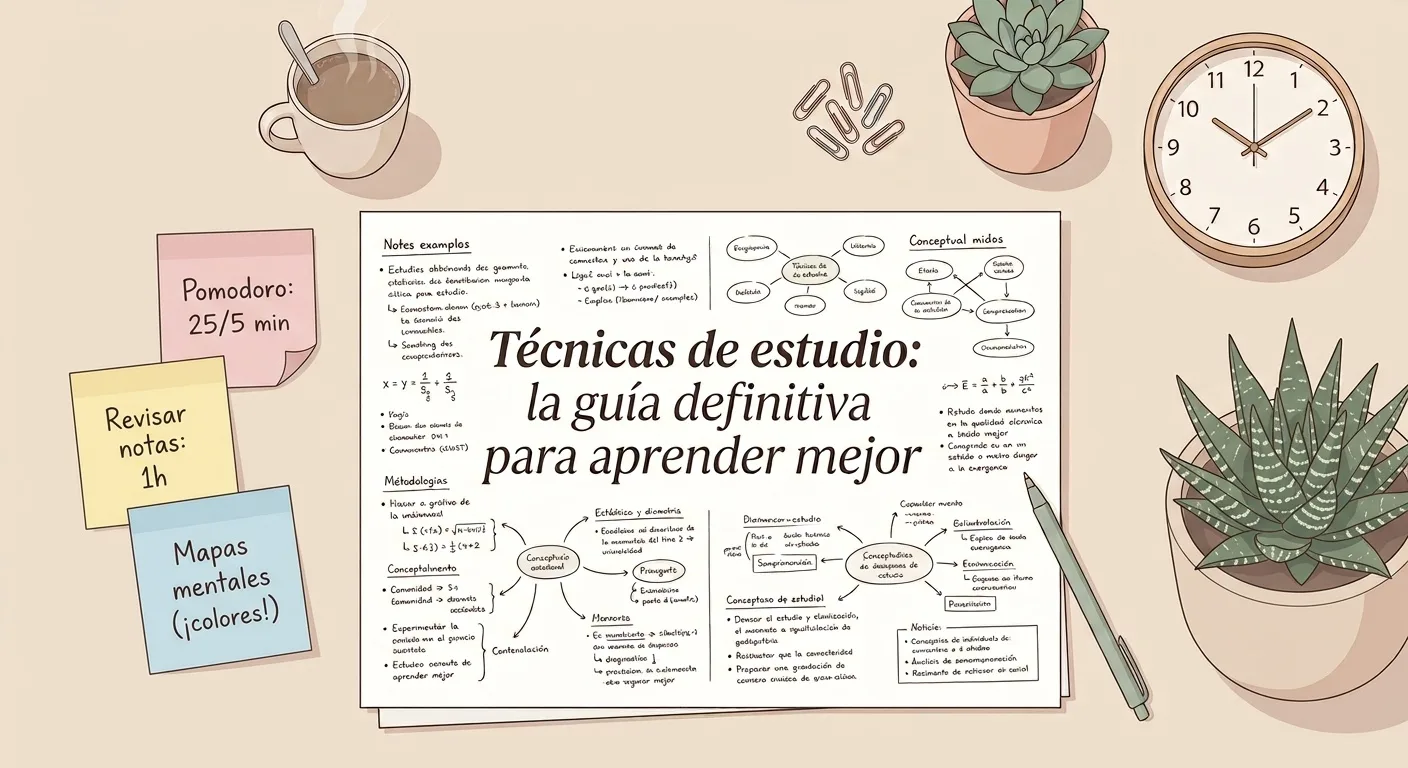
There is always someone who studies half as much as you and gets a better grade. They are hardly ever smarter, and they certainly do not have spare hours: what they do differently is how they use them.
That is the real problem, most of us still study the way we learned to at ten years old, rereading notes and running a highlighter over them, because nobody ever taught us anything else. And those two happen to be the worst-performing study techniques of all the ones out there.
In this guide you will see which ones actually work according to the evidence, which ones only give you a feeling of control, and how to combine them into a system you can start using this afternoon.
Key takeaways
- There are no good and bad techniques, only active and passive ones.
- Rereading and highlighting produce a feeling of control, not memory.
- Retrieval and spacing are the two best-supported techniques.
- An imperfect but consistent system beats the perfect technique.
What is a study technique, and why do so few qualify?
A study technique is a concrete, repeatable procedure for getting information into your memory and being able to pull it back out when you need it. Look closely at the second half of that sentence, because that is where almost everything you do falls apart: recognising content while it sits in front of you has nothing to do with remembering it when it is gone.
What separates one technique from another is a single variable, the retrieval effort it demands. If the material is in sight, your brain builds nothing, it only confirms. If it is not, your brain has to rebuild the whole route, and that work is what leaves a trace.
It is the difference between looking at a map and walking the city. With the map you recognise every street and feel confident; the day you head out without it, you discover you do not know which corner to turn at.
That is why a technique is not measured by what it teaches you, but by what it forces you to produce.
What works and what doesn't, at a glance
Cognitive psychology reviews have spent decades comparing the same techniques, and the result is uncomfortably stable, the most popular ones are not the most effective:
| Technique | Usefulness | Why |
|---|---|---|
| Active recall | High | Forces you to produce the answer unaided |
| Spaced repetition | High | Hits forgetting right before it happens |
| Interleaved practice | Medium-high | Trains you to pick the method, not just apply it |
| Self-explanation | Medium | Connects the new material to what you knew |
| Summarising in your own words | Medium | Works if you condense, not if you copy |
| Rereading | Low | Produces recognition, not recall |
| Highlighting | Low | Marks the text, does not process it |
| Mnemonics | Low except in specific cases | Good for closed lists, not for understanding |
Notice one detail about the top half of the table, none of those techniques asks you for new material or extra hours. They run on the same notes you already have; the only thing that changes is what you do with them.
The four techniques with the strongest evidence
If you are only going to adopt a few, make it these:
- Active recall: closing the material and trying to pull the information out of your own head. It is the technique with the most experimental support, and the phenomenon behind it has its own name, the testing effect: the attempt to remember does not just measure memory, it builds it.
- Spaced repetition: spreading reviews out over time instead of piling them up. Reviewing four times on four different days fixes far more than four times in one afternoon, because each review lands as the memory starts to fade. It is the direct answer to the forgetting curve.
- Interleaved practice: mixing problem types or topics within the same session, instead of doing thirty identical exercises in a row. It is harder and it feels like you are doing worse, but it trains the skill the exam actually asks for, deciding which method applies.
- Self-explanation: stopping after each block and explaining out loud why what you just read happens. It is not repeating the definition, it is answering the why in your own words and spotting where your explanation breaks down.
None of the four feels comfortable. That is exactly the sign that they are working.
The ones almost everyone uses and that barely help
This is where it pays to be honest, because these four take up most of the study time of almost any student:
- Rereading: each pass feels easier, and your brain reads that ease as mastery. It is the illusion of competence, and it is the number one reason for going blank in an exam you thought you were ready for.
- Highlighting: it isolates what matters, and that has value. The problem is that highlighting processes nothing: the decision of what to mark lasts a second, and after that the colour just sits there, giving you the impression that the work is done.
- Copying out summaries: transcribing a topic word for word is a manual activity, not a mental one. A summary only helps if it forces you to decide what gets left out.
- Studying according to your "learning style": the idea that you are visual, auditory or kinaesthetic and should only study through that channel is one of the most widespread beliefs in education and one of the worst supported. When it has been tested, matching the material to the declared style does not improve results. What does matter is the format the content demands: anatomy lands better with images and a language with audio, whoever you are.
None of the four is a sin. The problem starts when they take the place of studying instead of preparing for it.
How to build your system in four steps
Isolated techniques do not get you far; what pays off is chaining them. This is the minimum circuit:
- Capture the material once: organised notes are the raw material for everything else. If yours are an illegible notebook, start with how to take notes and spare yourself the rest of the problem.
- Turn it into questions the same day: when you finish a topic, convert each section into a question you can answer without looking. This step is what turns passive notes into retrieval material.
- Schedule your reviews, don't improvise them: a scheme that works is reviewing after 24 hours, 3 days, a week and a month. What you get right with ease moves to the next interval; what you get wrong comes back tomorrow.
- Mix topics in every session: work on two or three different blocks instead of emptying one. It will feel like more effort, and you will reach the exam with more flexibility.
Four steps, the same syllabus, and not one extra hour.
The three mistakes that ruin any technique
1. Switching technique every week
- Mistake: trying Cornell on Monday, flashcards on Thursday and pomodoro the following week, without giving anything time to settle.
- Fix: pick two techniques and hold them for a full month before judging them. Mediocre consistency beats the perfect technique you abandoned.
2. Studying what you already know
- Mistake: going over topic 1 ten times because it is the one you handle best, and reaching the exam without having opened topic 7.
- Fix: let the system decide for you. What you get wrong gets reviewed, what you get right waits.
3. Packing it all into the night before
- Mistake: classic cramming, six straight hours before the exam.
- Fix: it works for passing tomorrow and for remembering nothing next term. If you are short on time, at least break those hours into blocks with active recall in between.
How technology makes this easy
If you have read this far you will have spotted the problem, setting all of this up by hand takes almost as long as studying. Writing questions for every topic, making cards and keeping a review calendar is real work, and it is the reason most people end up back with the highlighter.
That is why at Selectiva App the tools are built on these same techniques, and they work with your own notes, not with content invented by a general-purpose AI:
- Quizzes from your PDFs: active recall with the exact questions from your syllabus.
- Automatic flashcards: the cards are already made, so your effort goes into remembering instead of writing them.
- Scheduled reviews: spaced repetition managed by the system, no paper calendars.
- Outlines and concept maps: the big picture of the topic before you go down into the detail.
If you want the detail on how to use artificial intelligence without it inventing half your syllabus, it is all in the guide on studying with AI.
Conclusion: a method can be changed in one afternoon
The study techniques that work are neither secret nor new, they have been measured for decades and they all point to the same place, the effort of pulling information out of your head instead of parading it in front of your eyes.
Start with one single thing, close your notes before deciding that you know them. The rest of the system gets built on top of that gesture.
You do not get to choose your talent. You do get to choose your method.
Frequently asked questions
What are the best study techniques?
Active recall and spaced repetition are the two with the strongest experimental support. Interleaved practice and self-explanation come next. Rereading and highlighting bring up the rear.
How long does it take to see results?
You get the diagnosis in the very first review session, because you find out what you did not know. The improvement in grades usually shows up from the second or third exam prepared with the full system.
Is it better to study for many hours in a row or in short sessions?
In short, spread-out sessions. The same number of hours split across several days retains considerably more than the same hours packed into one afternoon, because each review lands as the memory starts to fade.
Is there any point in studying according to my learning style?
There is no evidence that matching material to your declared style improves learning. What does matter is the format the content demands: images for anatomy, audio for languages.
Study better with your own notes
Upload your PDFs and Selectiva turns them into summaries, quizzes and flashcards in seconds.