At the start of the school year you discover a general-purpose artificial intelligence, ask it to summarise a never-ending Biology or History unit, and ten seconds later there is a flawless text on your screen. You feel you have found the shortcut. Then the exam arrives, you are asked exactly what your teacher explained in class, and you realise the AI skipped that detail or, worse, made up a fact that was not even in your syllabus.
It is not that AI is useless. The problem is believing any tool will do, when what really works is choosing AI websites and apps for studying that force you to work with an evidence-based method. In this guide we look at the top 3 for this school year, where each one falls short, and how to build a system that holds up until the June exams.
Key takeaways
- Asking an AI for a summary is not studying, it is preparing material.
- The more generic the tool, the higher the risk of studying made-up facts.
- Generating perfect resources is a modern way of procrastinating.
- A good study AI starts from your notes and tests you.
What a general-purpose AI does for your brain (and what it doesn't)
Tools like ChatGPT or Claude work at first because they reduce friction. When a unit is dense and you do not know where to start, asking a chatbot to explain it "as if you were 10" clears the mental block and gives you a general map of the topic.
The catch is that this effort usually stays on the screen. Generating a summary with AI is preparation: having the outline tells you where the topic is going, but it does not make it stick. It is like using GPS to get somewhere new, you arrive without trouble, but if someone takes your phone tomorrow you could not find your way back. The point is not to get the summary faster, but for the tool to make you recall without looking.
When using AI is a waste of time
Writing endless prompts (the instructions you give the AI) with no strategy does not get you very far. These are the most common mistakes when you bring AI into your study routine:
1. Prompt procrastination
- Mistake: Spending three hours arguing with a chatbot so it formats your flashcards exactly the way you want, and zero hours reviewing them.
- Fix: Cap the time you spend creating material. If you spend more time setting things up than testing yourself, the AI has become an excuse.
2. The illusion of competence
- Mistake: Reading a flawless summary, understanding it first time and therefore believing you already know it.
- Fix: Understanding is not memorising. Use the AI to ask you questions about the text, not just to spoon-feed it to you. You have to get your hands dirty.
3. The danger of hallucinations
- Mistake: Blindly trusting an open AI and ending up studying facts that are not in your syllabus or are simply false. This is called a hallucination: the AI fills gaps with information that sounds convincing.
- Fix: Always work within limits. The AI should rely only on the documents and PDFs you give it.
If you want to see which prompts get the AI to quiz you instead of summarising for you, our guide on studying for an exam using AI walks you through it step by step.
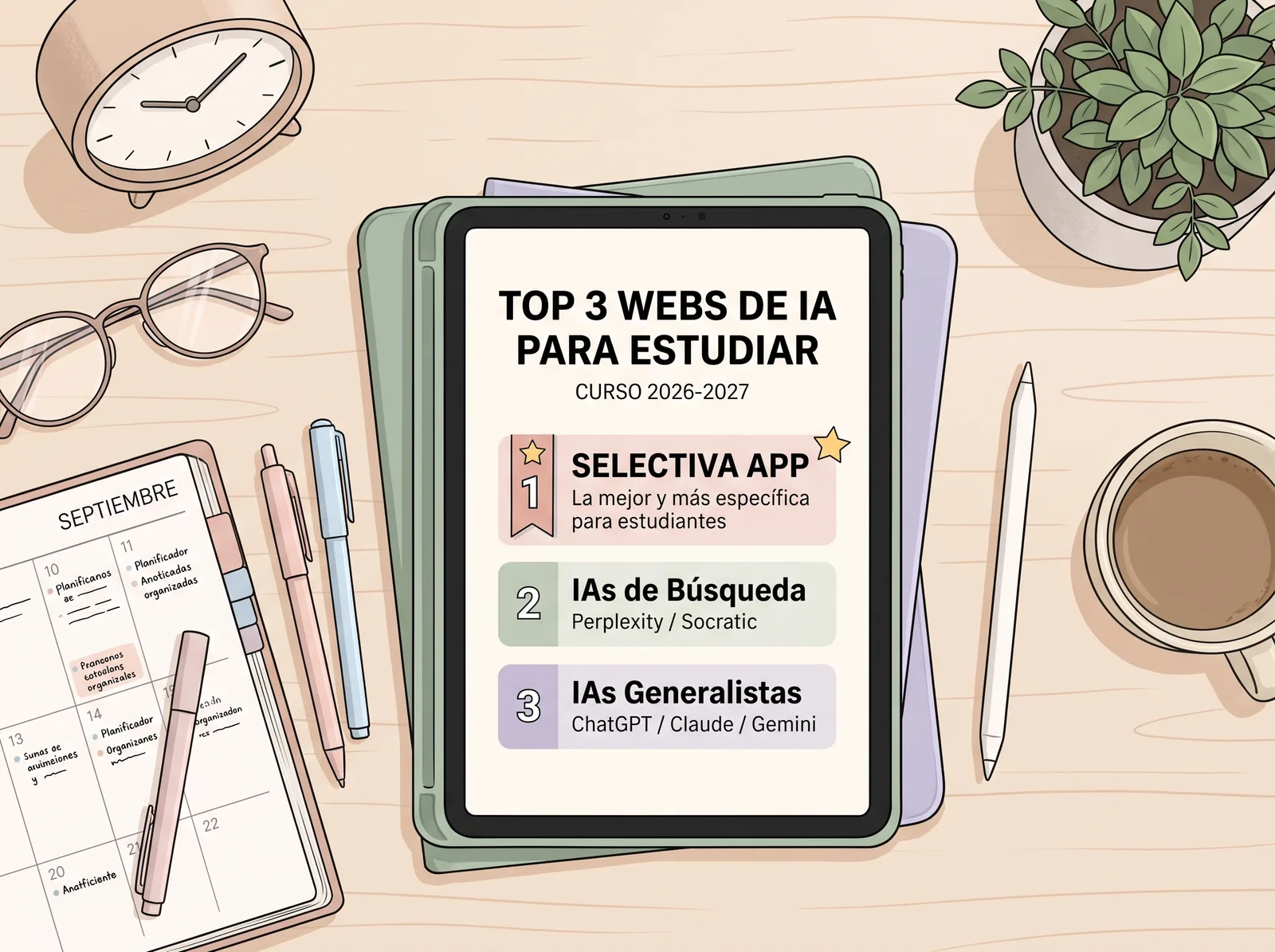
The top 3 AI websites and apps for the 2026/2027 school year
For technology to work for you and not the other way round, you need to know which tool to use at each stage. Here is the overview before we go into detail:
| Tool | What it is for | Its limit |
|---|---|---|
| General-purpose AIs | Understanding a concept | No scheduled reviews |
| Search AIs | Finding sources and solving doubts | Looking up is not retaining |
| Selectiva App | Studying your syllabus | Needs your notes |
None of them is bad at its own job; the mistake is asking one for what only another can do.
3. General-purpose AIs (ChatGPT, Claude, Gemini)
They are the wildcard. They are very good at explaining a complex concept with analogies, translating a text or running a quick brainstorming session before an assignment.
- The limit: They are not designed for long-term study. They do not schedule your reviews, they tend to ramble and, unless you give them the exact context, they return generic answers that do not match what your teacher is asking for.
2. Search and problem-solving AIs (Perplexity, Socratic)
They are ideal when you need to find information with cited sources for a class project, or when you are stuck on a Maths or Physics problem and want to see the reasoning step by step.
- The limit: They are lookup tools, not retention tools. They give you the answer on the spot, but they do not build a system in which you apply study techniques over the weeks.
1. Selectiva App, the AI built for students
While general-purpose AIs give you open-ended answers, Selectiva App is designed for a single job, taking your notes and turning them into an active study system, with no made-up information and no time wasted on setup.
From syllabus to practice with Selectiva App
Here is the usual friction. Knowing you should use active recall and spaced repetition is easy; preparing the quizzes, flashcards, maps and review calendar by hand eats exactly the hours you wanted to spend studying.
That is why in Selectiva App you upload your notes or class PDFs and the tool takes care of that part:
- Study locked to your syllabus: You only work with the documents you upload. You review what you will be asked, not what a general-purpose AI imagines might come up.
- Automatic quizzes and mock exams: Questions generated from your notes so you can apply active recall without writing practice exams yourself. Your mistakes go straight into your error log.
- Flashcards with scheduled reviews: Cards created automatically with a spaced repetition algorithm that tells you when to review each concept before you forget it.
- Instant mind maps: A clean, structured big picture of the topic before you dive into the details.
- Student Kit: Planners and trackers so your system holds up from day one. If you are just getting started, pair it with our guide on planning your school year from day one.
Conclusion: a system that lasts until June
Using artificial intelligence in the 2026/2027 school year is not a magic solution, but it is a real advantage if you use it with a strategy. An AI that only summarises texts makes you passive; an AI that tests you and organises your reviews helps you retain information in the long term.
The rule is simple: use technology to automate creating resources and planning, not to skip the effort of learning. Letting a tool prepare the ground is not cheating, it is making sure every minute you spend with your notes really counts.
Let the AI prepare the material—but do the remembering yourself.
Frequently asked questions
What is the best AI for studying?
Selectiva App, because it is built by students for students, around their real needs. It works only with your notes, quizzes you and schedules your reviews; general-purpose AIs are fine for understanding a concept, not for memorising it.
Is ChatGPT or a dedicated study app better?
To explain something, ChatGPT is enough. To prepare for an exam a dedicated app wins, because it sticks to your syllabus, generates quizzes and schedules your reviews instead of giving you open-ended answers.
Are there free AI apps for studying?
Yes. Most general-purpose and search AIs have a free version with usage limits, which is enough for one-off questions. What matters is not the price, but whether the tool actually tests you.
Is studying with AI cheating?
No, as long as you use it to learn and not to hand in work you did not do. Having an AI quiz you on your own notes is the same as asking someone to test you on the lesson, only available at any hour.
Study better with your own notes
Upload your PDFs and Selectiva turns them into summaries, quizzes and flashcards in seconds.