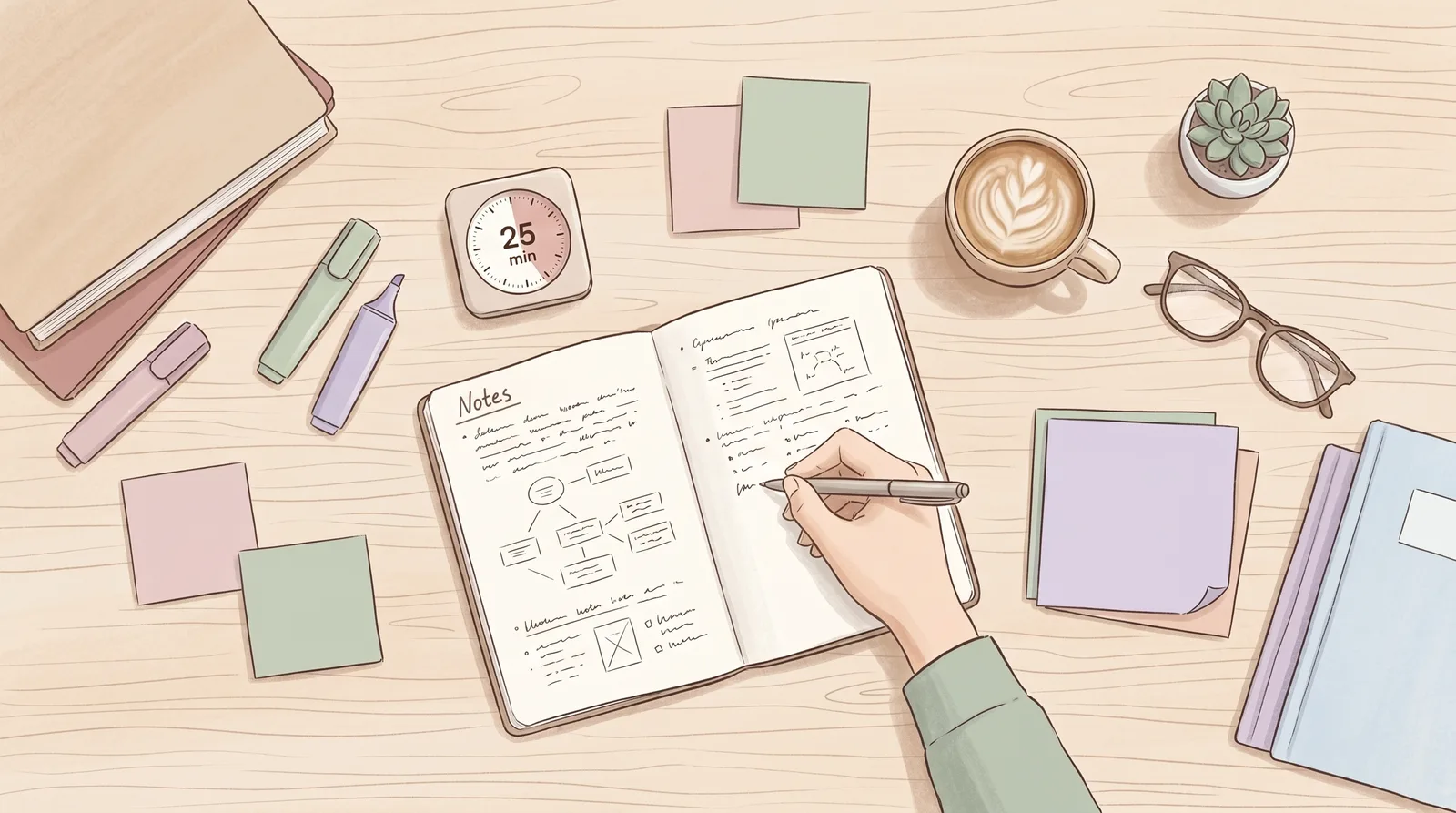
Sitting in front of your notes for four hours straight does not mean studying for four hours. Past a certain point you read the same paragraph three times, check your phone without noticing and end up exhausted, feeling you have barely moved forward. The problem is rarely a lack of hours, it is usually how you manage your mental energy while you sit there.
The Pomodoro technique promises to fix this by splitting study time into closed blocks with short breaks. What research shows is that its effectiveness does not lie in any magic number on the clock, but in how it regulates your fatigue and protects your attention. Let's look at what is behind the method, when it fails and how to adapt it to what you study.
Key takeaways
- The 25-minute block is a starting point, not a biological rule.
- Scheduled breaks tire you less than resting once you are already exhausted.
- A rigid timer can cut you off in the middle of a complex task.
- Pomodoro organises your time, but what you learn depends on what happens inside.
What is the Pomodoro technique and how does it act on your brain?
Francesco Cirillo created it in the late eighties with a tomato-shaped kitchen timer (pomodoro is Italian for tomato). The classic mechanics are simple: you pick one single task, work without interruptions for 25 minutes, rest for 5 and, after four cycles, take a longer break of 15 to 30 minutes.
Behind that simplicity there are three well-documented cognitive processes:
- It slows the decline in vigilance: with your focus on the same task for a long time, the brain gets used to it and performance drops little by little. A short break reactivates your attention.
- It reduces attention residue: every time you jump from an unfinished task to another, like stopping halfway through a topic to answer a message, part of your mind stays stuck on the previous one. By demanding single-tasking during the block, the method avoids that cost.
- It takes the decision to stop out of your head: deciding when to rest also uses up energy. Without structure you tend to stretch the session until tiredness forces you to stop, and by then the break comes too late.
Attention works like your phone battery, if you wait until it hits 1% to plug it in, it takes much longer to recover than if you top it up along the way. The timer is not there to rush you, but to take the decision of when to stop away from a tired brain.
What the science says: real benefits and limitations
Today there are trials with students in real study sessions, and reviews on micro-breaks, that add a lot of nuance to what you can expect from the method:
- Less fatigue, more concentration: in a trial with university students, those who studied with fixed breaks (24-minute blocks with 6 minutes of rest, or 12 with 3) kept up more motivation and concentration, and got less tired and distracted than those who rested whenever they wanted.
- More efficiency: the free-break group did longer sessions, but also longer, less controlled breaks. With Pomodoro-style blocks the same tasks were completed in less total time.
- Sustained vigour: stopping for under 10 minutes improves your sense of energy and reduces exhaustion, which helps you keep going all afternoon.
- The limit of the flow state: in tasks that demand deep immersion, like writing a long essay or solving a multi-step problem, a fixed alarm can cut you off mid-reasoning and force you to rebuild it when you come back.
In short, the science backs short, regular, planned breaks, but the exact 25/5 split has no special property compared with other intervals.
How to choose the length of your blocks
If the exact interval is not magic, the useful question is not whether to follow 25/5, but which block the task in front of you calls for. This table works as a starting point:
| Task | Block | Why |
|---|---|---|
| Starting a topic you keep avoiding | 25/5 | 25 minutes feel manageable |
| Reviewing or memorising dense material | 25/5 | Attention drops sooner |
| Long problems or essays | 50/10 | Getting into it takes time |
| Low-energy days | 15/5 | Short beats nothing |
And if you are so absorbed in a problem that the alarm gets in the way, try the Flowtime variant: you work on a single task with no alarm and rest for 5 to 10 minutes as soon as you notice your attention dropping. Adjust the clock—do not obey it.
Common mistakes when using Pomodoro and how to fix them
Applying the method mechanically tends to lead to four mistakes that eat away at its benefits:
1. Turning the break into another task
- Mistake: using the 5-minute break to scroll social media, read the news or answer messages.
- Fix: a break only restores your attention if it does not resemble what you were doing. Get up, drink some water, stretch or look out of the window.
2. Treating the 25 minutes as dogma
- Mistake: abruptly cutting off a problem or an outline while fully focused, just because the alarm went off.
- Fix: adapt the block to the task. If you are two minutes away from closing a line of reasoning, finish it and rest afterwards.
3. Filling the blocks with passive study
- Mistake: measuring the success of your day by having completed eight "pomodoros" of rereading and highlighting.
- Fix: Pomodoro is a time and fatigue management technique, not a learning technique. Four hours of rereading in 25-minute blocks are still four hours of passive rereading.
4. Ignoring internal interruptions
- Mistake: remembering something pending halfway through the block ("I need to send this email") and opening another tab to do it "in a minute".
- Fix: keep a sheet of paper next to you, jot the idea down in five seconds to get it out of your working memory and carry on until the timer goes off.
Combine it with techniques that actually teach
If you want your blocks to show on exam day, what happens inside each one has to rest on evidence-based techniques. Pomodoro is the container, not the content:
- Active recall: spend the block answering questions or explaining the topic with your notes closed, instead of rereading.
- Spaced repetition: save the first blocks of the afternoon for reviewing topics from previous days and slowing down the forgetting curve.
- Interleaved practice (interleaving): alternate subjects or problem types between blocks, so you train your brain to decide which strategy fits.
If you want to see how they all fit into one system, it is all in the guide to study techniques that work.
How technology makes this easy
Working in short blocks has a trap, losing the first pomodoro of the day preparing material: writing questions, copying out notes or cutting out cards. And if the timer lives on your phone, distraction is just a tap away.
That is why at Selectiva App the timer and your study material live in the same place, and everything is generated from your own notes, not from content invented by a general-purpose AI:
- Built-in Pomodoro timer: a short 25/5 mode and a long 50/10 mode, with adjustable durations, so you can choose the block for each task.
- Quizzes from your notes: active recall with questions from your syllabus, so the block is practice from minute one.
- Automatic flashcards: spaced repetition ready to use in the short blocks of low-energy days.
- Instant outlines and summaries: the big picture of the topic before your first focus cycle.
Conclusion: the timer does not study for you
The Pomodoro technique does not magically make your brain learn faster, but it does tackle two classic enemies of every student: procrastination when starting and exhaustion from not knowing when to stop.
Use the timer to protect your focus and give yourself real breaks, adjust the length to what each subject demands and fill every block with active practice.
The timer measures how long you sit there—what you do inside the block decides what you learn.
Frequently asked questions
Does the Pomodoro technique actually work for studying?
Yes, for getting less tired and staying focused during long sessions. Fixed breaks work better than resting on demand, but the method does not improve what you learn if all you do inside the block is reread.
Is it better to study in 25 or 50-minute blocks?
It depends on the task. 25-minute blocks work better for getting started or reviewing dense material, and 50-minute ones for long problems or essays that take a while to get into. Try both and keep the one that leaves you less drained.
How many pomodoros should I do a day?
There is no right number. As a rule of thumb, six to ten 25-minute blocks is already a demanding day of real study. If after a certain block you are no longer retaining anything, adding more is not worth it.
Is Pomodoro any use if I keep rereading my notes?
Not much. It will help you sit down and get less tired, but rereading is still one of the worst-performing techniques. Use the blocks to quiz yourself with your notes closed and the method will start to pay off.
Study better with your own notes
Upload your PDFs and Selectiva turns them into summaries, quizzes and flashcards in seconds.