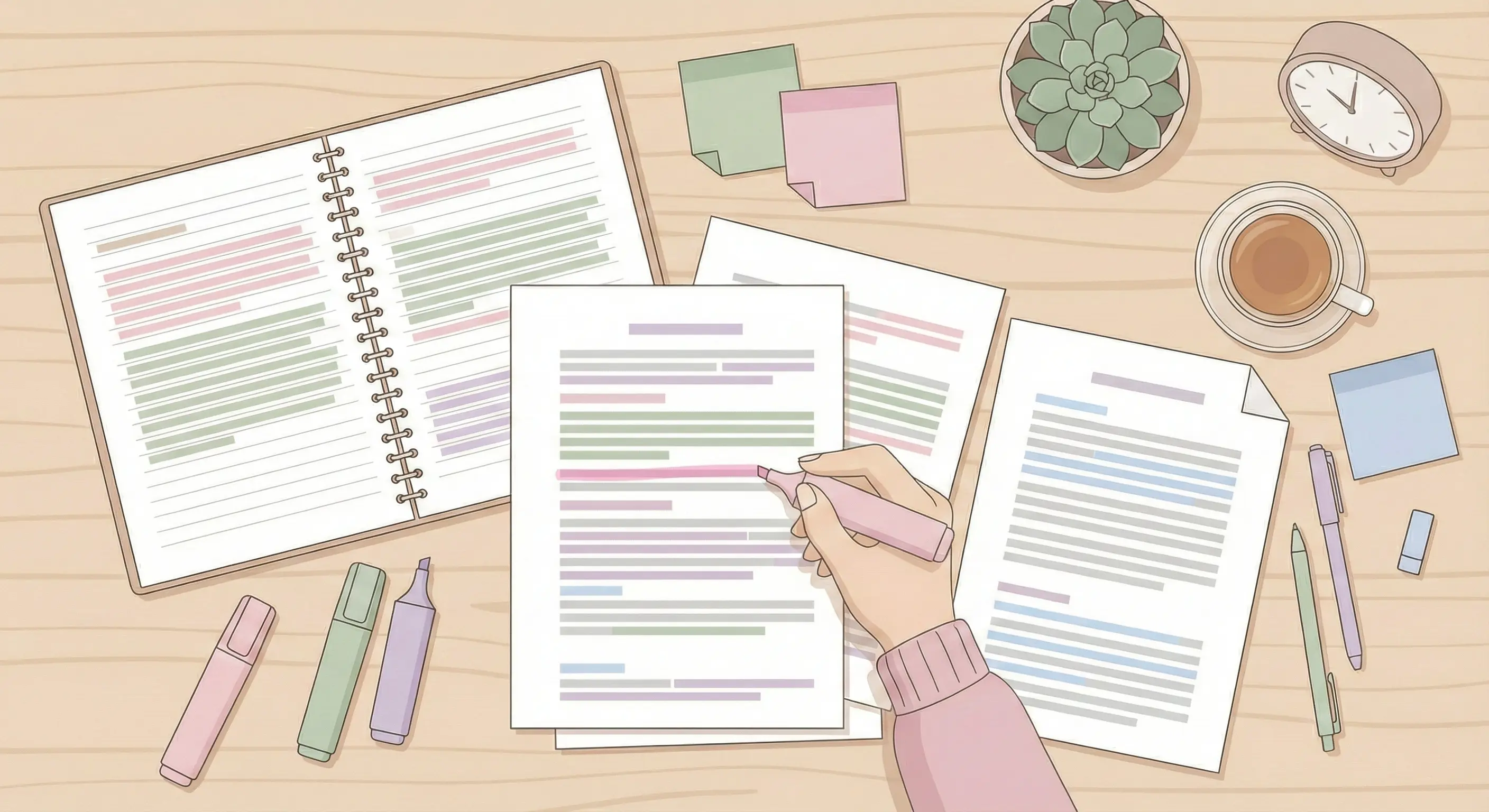
Underlining is one of the most popular study techniques among students. The idea is simple: mark key ideas to facilitate review and memorization. However, science warns that underlining on its own contributes little in the long term. It is often believed that highlighting guarantees learning, but several scientific reviews indicate otherwise.
How underlining works: Cognitive bases
Underlining is a visual encoding process where fragments of text are highlighted to draw attention to them. This takes advantage of the isolation effect (or Von Restorff effect): highlighted information "stands out" sensorially from the rest, making it easier to remember. Additionally, it forces the student to briefly focus on each marked idea. However, this effort is usually superficial. In other words, underlining is passive; without subsequent reflection, it amounts to knowing something is important without deeply understanding it.
Benefits of underlining: Why can it be useful?
Although it is a limited technique, underlining can be useful if used with discretion. One of its main advantages is that it promotes focused attention. By marking the most important ideas, we direct our eyes toward the essentials. During review, the gaze immediately centers on the underlined parts, allowing for better focus on key concepts and speeding up the process by avoiding the need to reread the entire paragraph.
Another advantage is visual distinctiveness, related to the Von Restorff effect. Highlighted elements stand out against normal text, making them more likely to be remembered as the brain tends to notice and retain what is unique.
Finally, underlining can serve as a basis for creating outlines or summaries. While it does not replace these techniques on its own, well-executed underlining helps identify fundamental concepts that can later be organized and processed through more active study methods.
When it is a waste of time
Highlighting without a clear strategy can be practically useless. Various studies warn of common mistakes, such as excessive underlining. When too much text is marked or full sentences are underlined, everything stands out equally and focus is lost. The more you underline, the less you benefit from visual isolation; therefore, it is recommended to highlight only a few consecutive words to avoid canceling out the Von Restorff effect.
Another common problem is shallow studying. Underlining can become a mechanical action if not accompanied by reflection, turning into a low-effort strategy that only provides the illusion of studying.
There is also the frequent false sense of mastery of the content. Experts point out that this "illusion of knowledge" is very common because, after underlining a paragraph, many students believe they have mastered it when they actually still need to work with it actively.
Added to this is the opportunity cost. Spending too much time underlining can take time away from much more effective memory techniques, such as active recall or spaced repetition. Relying solely on underlining can prevent investing time in these higher-impact methods.
Finally, using inappropriate colors can be counterproductive. Very bright tones or an excess of colors can strain the eyes without providing additional benefits. Soft or pastel colors are recommended for long study sessions, as well as limiting the number of highlighters used. A disorganized color code without logic can be more distracting than helpful.
How to underline effectively
To make the most of underlining without it being useless, follow these expert-based guidelines:
- Read before underlining: Do not mark anything during your first reading. First, understand the full text, and then do a second pass to highlight only the essentials.
- Mark minimal key ideas: Limit each underline to a few words or central phrases. Do not mark entire sentences; use your judgment.
- Use different colors with purpose: Implement your own code (e.g., one color for key concepts, another for definitions, another for authors, etc.). Pastel tones are preferred, and avoid using more than 3–4 colors.
- Annotate in the margins: Accompany underlining with brief notes or symbols (arrows, brackets, numbers) that clarify relationships between concepts. This forces you to process the underlined information more actively.
- Do not rely only on sight: After underlining, review it by writing or speaking in your own words. For example, turn the underlined part into a question or a flashcard. This active recall step is key: it turns a simple visual mark into true learning.
Combine underlining with other techniques
Underlining performs best when integrated into a broader study system. Some useful additions include:
- Active Recall: After underlining, generate practice questions based on the highlights. Self-testing reinforces retention much more than passive rereading.
- Spaced Repetition: Revisit the underlined material at scheduled intervals. Science shows that spacing out reviews fixes memory better than last-minute cramming.
- Summarizing and Outlining: Use the underlined material to create summaries or concept maps.
- Elaboration and Self-explanation: Explain out loud what you have underlined and why it is important.
Conclusion
Underlining is not a panacea, but it is not useless if used wisely. Specialized research agrees that on its own, underlining contributes very little to long-term retention. However, used correctly, it can save time during review and guide your study.
This is precisely where using the right tools makes sense. In Selectiva App, you can underline summaries strategically and, most importantly, reinforce that content through active recall and spaced repetition. It’s not just about marking text—it’s about turning it into real, lasting learning.