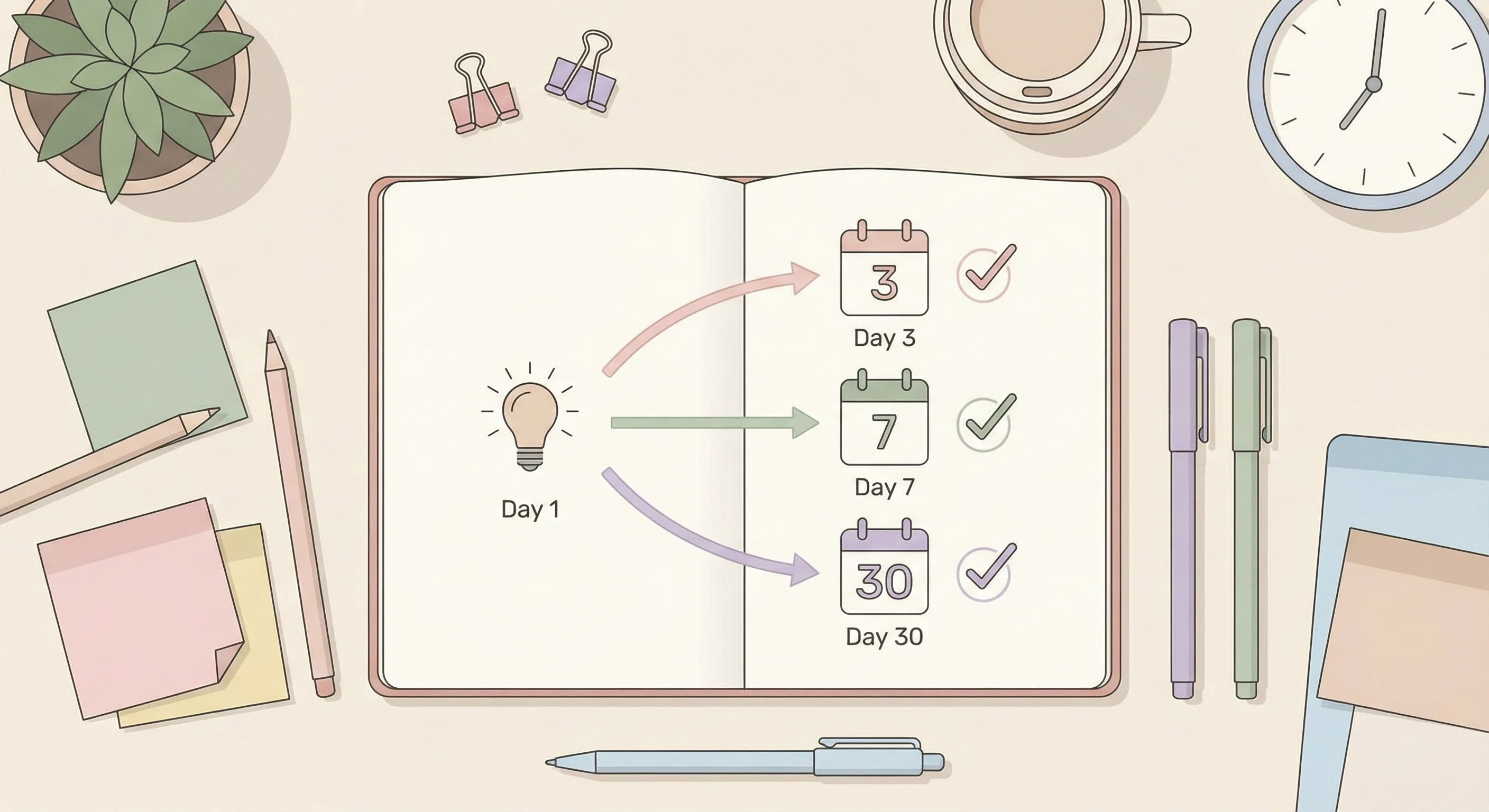
If you are reading this, it is surely because you are wondering: What is spaced repetition? And how does this help me study?
In recent times, this technique has become quite popular among students thanks to its high effectiveness, and it is not something subjective; it is a technique backed by multiple scientific studies and is capable of ensuring we retain information much better in the long term (Quite the opposite of "cramming" to memorize everything at once for the exam only to forget everything by next week).
How does spaced repetition work? The science behind the method
The spaced repetition method is based on the forgetting curve, a concept discovered by psychologist Hermann Ebbinghaus in the 19th century. This curve shows how information fades from our memory exponentially after initial learning.
The key lies in reviewing the information just before we forget it. Every successful review strengthens neural connections and reduces the slope of the forgetting curve, allowing the intervals between sessions to become increasingly longer.
The key scientific principles are:
- Spacing effect: We learn better when study sessions are distributed over time.
- Retrieval practice effect: Actively recalling information is more effective than simply rereading it.
- Optimal intervals: There are ideal moments to review that maximize retention.
Benefits of spaced repetition for studying: Why should you implement it?
Efficient long-term memorization
The spaced repetition technique moves us from a hard memorization process to a more systematic and predictable one where we gradually get more accustomed to the concepts and manage to internalize them much more, achieving in some cases even a 200% improvement in retention when compared to other more traditional study methods.
Significant time savings
By focusing on what you are about to forget and skipping what you have already mastered, you significantly reduce total study time. Often saving up to 50% of the time, one can master the same amount of content.
Versatile Application
This method works for multiple disciplines:
- Studying languages and vocabulary
- Preparing for medical, law, or engineering exams
- Learning scientific or mathematical concepts
- Memorizing historical facts or important dates
Reduction of academic stress
One of the strongest points of this technique is that we avoid burnout since we distribute study sessions better; this way, we approach sessions with greater motivation and achieve higher performance and peace of mind.
How to implement spaced repetition in your study routine
Manual system: The Leitner method
One of the most accessible systems uses physical index cards and boxes:
- Create study cards (flashcards) with questions and answers.
- Sort the cards into different groups according to difficulty.
- Establish a review schedule that increases intervals for mastered cards.
- Difficult cards are reviewed more frequently.
Specialized software: Spaced repetition apps
At Selectiva, we have created a digital platform where you can create a personalized study plan using learning techniques tested and grounded in scientific studies.
Thanks to our intelligent algorithm, an optimal learning path will be generated based on the deadline you establish, combining all types of resources, such as flashcards, summaries, and quizzes.
With Selectiva, you not only get a tool but a complete efficient study system that adapts to you, eliminating complexity and maximizing your long-term retention.
Common mistakes when using spaced repetition and how to avoid them
1. Creating poor quality cards
- Mistake: Questions that are too simple or complex.
- Solution: Formulate questions that require active thinking.
2. Lack of consistency
- Mistake: Skipping review sessions.
- Solution: Integrate reviews into your daily routine.
3. Information overload
- Mistake: Trying to memorize too much at once.
- Solution: Focus on key concepts first.
4. Ignoring context
- Mistake: Memorizing isolated facts.
- Solution: Connect information with previous knowledge.
Enhance your experience with spaced repetition by mixing it with other techniques
Although spaced repetition is one of the techniques that yields the best results when learning and internalizing knowledge, it is recommended to combine it with other techniques to maximize results.
Some of the techniques with which it has good synergy are:
- Distributed practice (studying in short and frequent sessions)
- Elaboration (connecting new information with what you already know)
- Self-explanation (verbalizing concepts in your own words)
Conclusion: Transform the way you learn with spaced repetition
Implementing spaced repetition in studying is not just another technique: it is a paradigm shift in how we approach learning. This methodology based on scientific evidence offers a clear path toward efficient and lasting memorization, allowing you to master any subject with less effort and greater enjoyment.
Whether you are studying for university exams, learning a new language, or developing professional skills, the spaced repetition technique can be your most powerful ally. Start with a simple system, be consistent, and watch how it transforms not only your academic results but your relationship with lifelong learning.