This has happened to almost all of us at some point: you spend hours highlighting notes and rereading texts, you feel like you know the material, but when the exam arrives, your mind goes completely blank. Why does this happen?
The short answer is that you have fallen into the "illusion of competence." The full explanation lies in a neuroscience-backed technique that will change the way you study: active recall (Active Recall).
What is active recall and why does your brain need it?
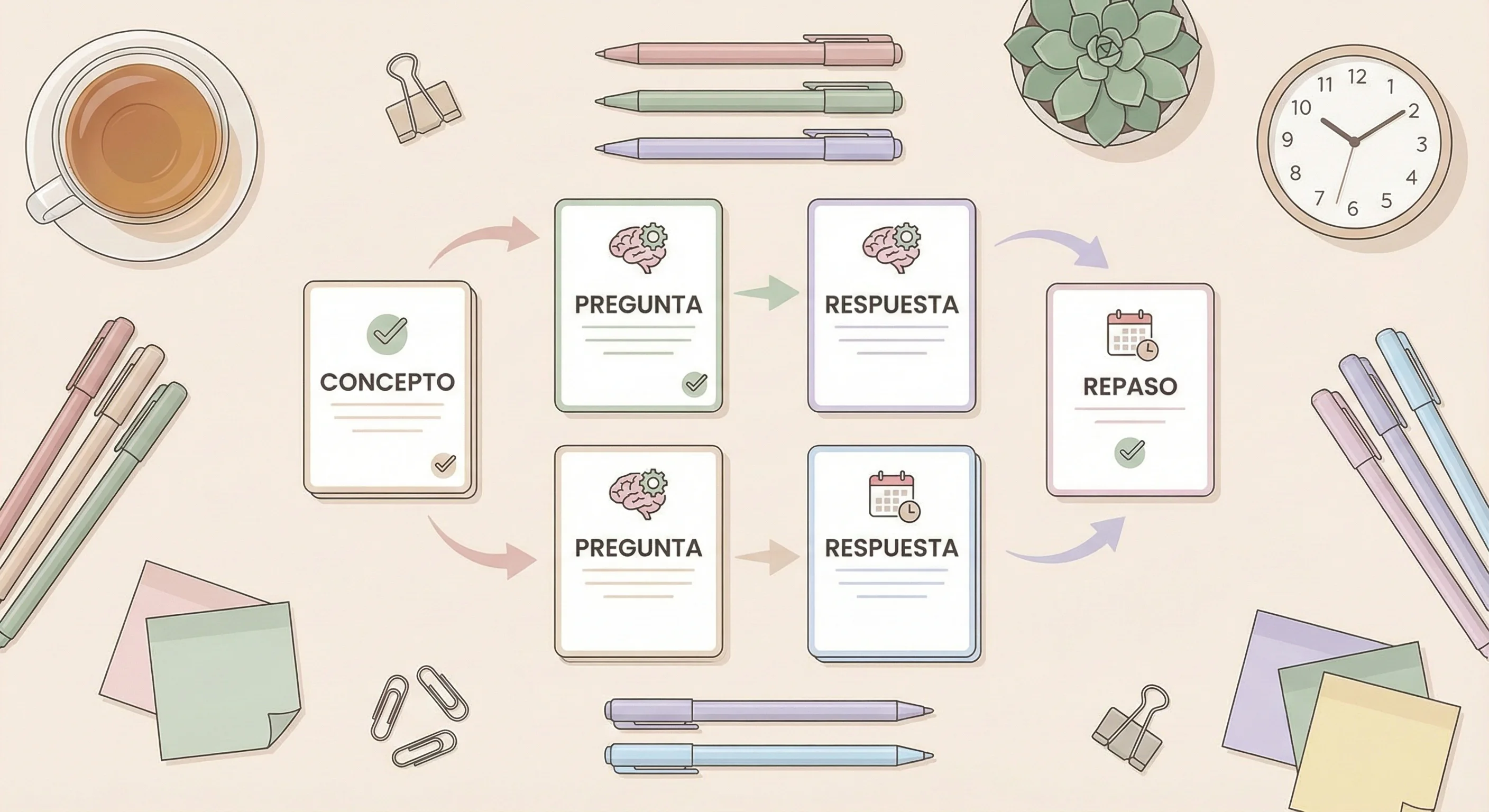
Unlike passive study techniques (such as rereading notes, highlighting, or listening to classes), active recall consists of forcing your brain to retrieve information from memory without external help.
The science behind this method is based on the "testing effect". Numerous studies in cognitive psychology have shown that the act of trying to remember something changes memory. When you struggle to recall an answer, you strengthen the neural connections associated with that information.
In short, you do not learn in order to remember; you remember in order to learn.
What science says: why you should apply it
Putting the highlighter aside and starting to test yourself has clear advantages:
- Breaks the illusion of competence: When rereading, you recognize the text and believe you know it. When you try to recall it without looking, you immediately realize what you truly know and what you do not.
- Long-term retention: The cognitive effort is what consolidates knowledge in long-term memory.
- Identifies knowledge gaps: It works as a real-time diagnosis and optimizes your study time.
How to integrate active recall into your daily routine
If you prefer analog studying, you can apply the blank sheet method and Blurting:
- Cornell Method: Write questions in the left margin and answers on the right. When studying, cover the answers and try to respond.
- Blurting: Read a topic, close the book, and write everything you remember. Then fill in what is missing.
- Close the book: Move the original material away before trying to explain the concept.
Preparing all of this by hand takes a lot of time. This is where technology becomes your ally.
At Selectiva App, the tools are designed around the principles of active recall. You can automatically generate quizzes, smart flashcards, and outlines so you can focus on learning.
The goal is to automate material creation and dedicate your mental energy to the effort of remembering.
Common mistakes when using active recall and how to fix them
- Checking the answer too soon
- Error: Giving up at the first second of doubt.
- Solution: Give yourself time. That effort is where real learning happens.
- Doing it only once
- Error: Answering correctly and never reviewing it again.
- Solution: Repeat retrieval in a spaced manner.
- Believing it is a waste of time
- Error: Thinking that reading is faster.
- Solution: It is slower at first, but it prevents hours of re-studying.
Boost its effectiveness by combining it with other techniques
Active recall becomes even more powerful when combined with:
- Spaced repetition: Use increasing intervals to defeat the forgetting curve.
- Interleaving: Mix different topics within the same study session.
Conclusion: transform passive study into active learning
Active recall requires more mental energy than reading, and that is precisely the sign that it is working.
Do not study more hours—study smarter. Whether using analog methods or Selectiva App, start testing your brain today.