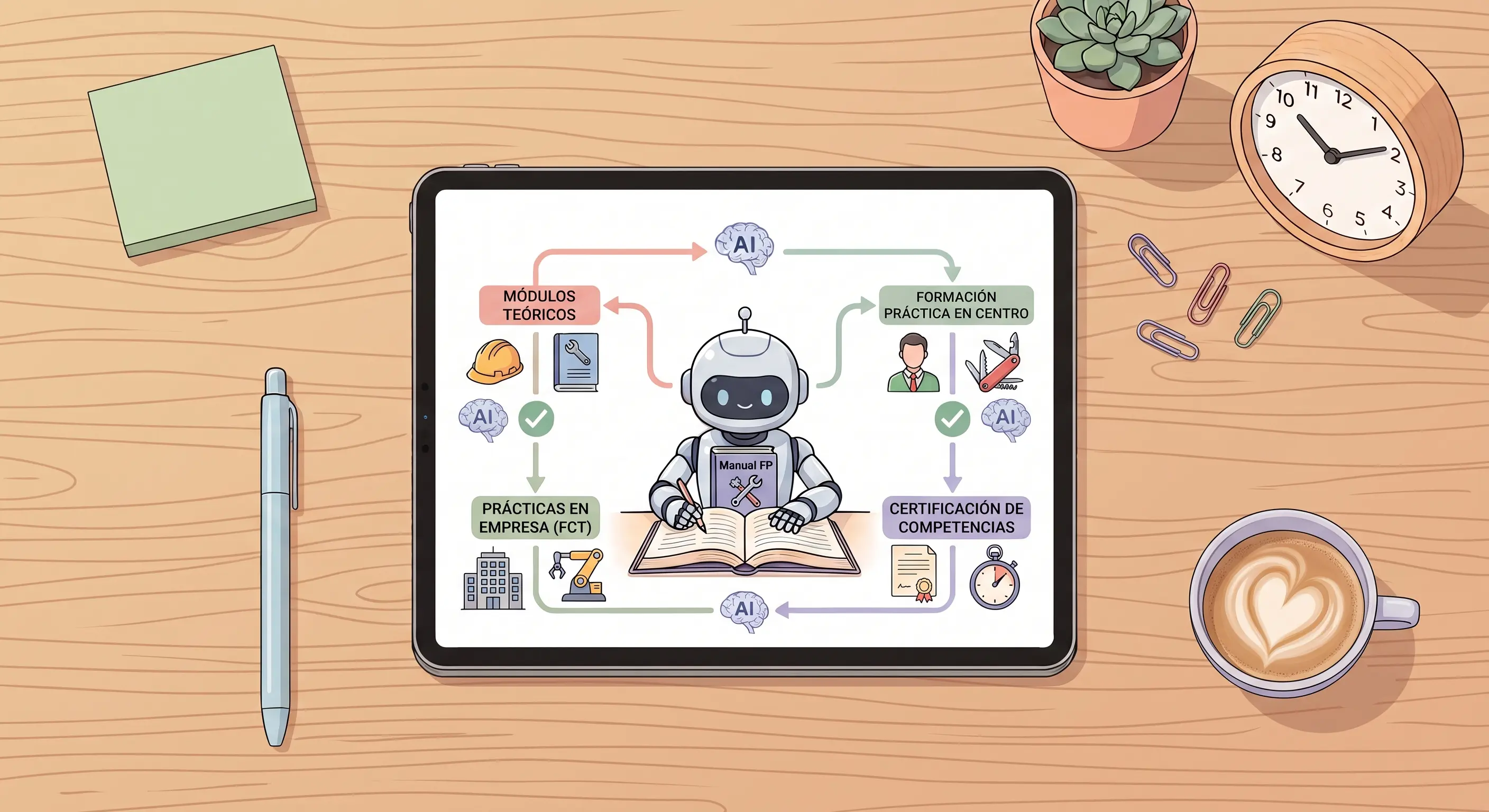
For years, vocational education (FP, Formación Profesional) was unfairly seen as a second option. Today it is the educational path with the highest employability rate in Spain. It is no longer just about learning a trade, but about specializing in technology, healthcare, and service sectors with a practical methodology that university sometimes fails to cover.
But make no mistake: although FP is practical, the level of demand has risen. Whether it is to pass the modules or to earn the average grade that opens the door to university, you have to study. And that is where many students get stuck.
Key takeaways
- FP works like a staircase: you can enter and climb at several points.
- A Higher Degree grants direct university access with no general exam phase.
- FP theory exams are dense: hands-on practice alone is not enough.
- Studying processes and protocols demands active techniques, not rereading.
The FP map: which types exist and what they are equivalent to
FP is designed as a staircase: you can start at the bottom or jump to higher steps depending on your previous education.
| Type of FP | Access requirements | Academic equivalence |
|---|---|---|
| Basic Degree | Completed 3rd year of ESO | ESO Graduate certificate |
| Intermediate Degree | ESO certificate | Technician certificate |
| Higher Degree | Bachillerato or Intermediate Degree | Higher Technician (higher education) |
On top of that, two modalities change the experience considerably:
- Dual FP: the jewel in the crown. You learn by working: part of the training happens at the school and a large part at a real company, often paid.
- Distance FP: ideal if you need to combine studying and working. It offers total flexibility, but demands iron self-discipline and tools that keep you focused.
Career prospects: where FP takes you
Versatility is its greatest strength. When you finish a cycle, two doors open:
- The labour market: companies are looking for specialists. A Higher Technician usually finds work faster than many university graduates, especially in IT, renewable energy, or healthcare.
- University: with a Higher Degree you get direct access without sitting the general phase of the EBAU. Your average grade from the cycle counts as your admission grade, and you only need to take the specific subjects if you want to raise it for a highly competitive degree.
The big challenge: FP has to be studied too
However you get in, today's FP is not just about "doing things". Theory exams are dense, technical protocols have to be learned, and regulations change constantly.
The common mistake is studying FP as if it were secondary school: reading and repeating. Cycle content is full of processes, technical terminology, and logical structures that require deep understanding, not empty memorization. A badly learned protocol does not show when you read it; it shows when you apply it.
How to study in FP: science on your side
To stand out in a training cycle, the key is not more hours but evidence-based techniques. The best FP students no longer waste time highlighting endless pages.
The method that works consists of turning the resources your teacher gives you (PDFs, slides, notes) into interactive material. Why?
- Active recall: instead of reading, you test yourself with questions. That forces your brain to retrieve the information and strengthens the associated connections.
- Spaced repetition: studying hard for one day and forgetting it is useless. The key is reviewing right before the concept fades.
Both fit FP especially well, because technical terminology and protocols are exactly the kind of content that fades fast and comes back well with repeated practice.
Selectiva App: turn your module materials into practice
If you are taking an FP and feel overwhelmed by your notes, the problem is usually not the amount of material, but that it is in a format you cannot study actively.
At Selectiva App you upload the materials your teacher provides and the platform turns them into:
- Smart summaries: to capture the essence of the module without the fluff.
- Custom flashcards: ideal for memorizing technical terms and protocols.
- Quizzes of several types: to simulate the real exam and find your weak spots before it is too late.
- Concept maps: to visualize how the processes relate to one another.
Conclusion
Vocational education stopped being a plan B a long time ago: it is a fast route into employment and, on top of that, a fairly comfortable side door into university. But that only holds if you pass your modules with a solid average.
Do not study like it is the last century. FP is the future, and the way you prepare for it should match.
Frequently asked questions
What do you need to access a Higher Degree in FP?
A Bachillerato certificate or an Intermediate Degree. You can also enter through the access exam if you are 19 or turn 19 that year.
Can you go to university after FP?
Yes. With a Higher Degree you get direct access without the general phase of the EBAU, and your average grade from the cycle counts as your admission grade.
What is the difference between Dual FP and standard FP?
In Dual FP a significant part of the training takes place at a real company, often paid, instead of being concentrated at the school.
Is FP easier than Bachillerato?
It is not easier, it is different: there is more hands-on work, but the theory exams are dense and full of technical terminology and regulations you have to master.
Study better with your own notes
Upload your PDFs and Selectiva turns them into summaries, quizzes and flashcards in seconds.